
Your rep has the perfect account. The product fits, the timing looks right, and there's a VP of Operations who clearly owns the problem. Three months of cold emails later, the VP still hasn't replied.
Then you hear a competitor is already in, introduced by someone on the account's board.
That's how a lot of enterprise deals are won and lost. Product, pricing and process matter, but the deciding question is often simpler: can you reach the people who decide, through someone they already trust? Most enterprise sales playbooks skip that question. Every step below comes back to it.
What is enterprise sales?
Enterprise sales is the process of selling to large organizations, where deals are big, cycles are long and a group of people decides rather than one buyer. It usually involves security, legal and procurement reviews, a named economic buyer, and a team that works a small number of high-value accounts in depth.
What makes enterprise deals different
The buying committee.
Gartner's 2025 survey of 632 B2B buyers found that buying groups range from five to 16 people across as many as four functions. The same research found that 74% of buying groups show unhealthy conflict during the decision, while groups that reach consensus are 2.5 times more likely to report a high-quality deal. You're not selling to a person. You're helping a group agree.
The long cycle and its gates.
ICONIQ's 2026 State of Go-to-Market survey puts the average B2B sales cycle at 19 weeks, and 24 weeks for deals over $100,000 ACV. Security questionnaires, legal redlines and procurement each add their own stage, and each is a place where a quarter can slip.
The trust problem.
In Gartner's 2025 survey, 73% of B2B buyers said they actively avoid suppliers who send irrelevant outreach. AI has made outbound cheap and inboxes louder, so senior buyers lean even harder on people they already know. When Norwest asked 177 B2B sales and marketing leaders about their most effective outreach tactics in 2025, 65% put warm referrals from customers or their network in their top three.
How to build an enterprise sales strategy, step by step
1. Pick fewer accounts and go deeper
Enterprise teams that chase 500 accounts end up with 500 shallow ones. Pick a smaller set you can actually work: tier one gets a named AE, an executive sponsor and a full account plan; tier two gets a lighter plan; everything else waits.
Choose tier-one accounts on fit first (industry, size, the problem you solve, the tools they already run), then on timing signals such as a new executive, a funding round or a public initiative that matches your product.
Example: a security company with 12 AEs picks 50 tier-one accounts, about four each. That's few enough that every AE can map every buying committee, and many enough to build a real pipeline.
2. Map the buying committee before you reach out
Stakeholder mapping comes before outreach, not after the first meeting. For each tier-one account, name the people in five roles:
- Economic buyer: owns the budget and signs.
- Champion: wants you to win and will sell internally when you're not in the room.
- Technical evaluator: decides whether the product works in their environment.
- Procurement: decides the terms.
- The quiet blocker: often security, legal or the sponsor of an incumbent tool.
Example: at a bank, the CFO may own the budget while the Head of IT Risk can stop the deal outright. If you only know the CFO's name, you don't have a map yet.
3. Build an access plan for every target account
This is the step most strategies miss. For each person on the map, ask one question: who in our company, board, investor base, advisors or customer list already knows them?
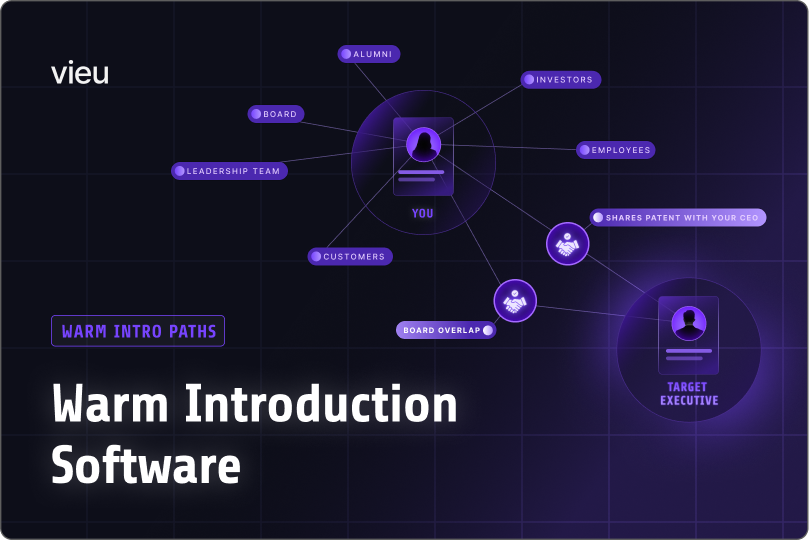
Answering that by hand means asking around in Slack and hoping. Vieu answers it from a graph of 4 billion people and companies and 14 billion inferred and verified relationships, built from shared work history, board seats, co-authored research and joint ventures. So the paths show up even if nobody on your team has ever logged them, ranked by how strong each relationship is.
The output is an access plan: for each stakeholder, the best introducer, the strength of the tie and the next step. Accounts with a strong path move to the front of the queue. Accounts without one get a sharper cold approach, built from step 4. Vieu is built to find these executive paths into strategic accounts.
4. Lead with a point of view, not a demo
Senior buyers take first meetings that teach them something. Before the meeting, read what the account has said publicly: the last earnings call, the 10-K or annual report, recent leadership interviews. Then come in with a view on their problem and what it's costing them.
Example: if a retailer's CFO told analysts that inventory write-downs hurt margins last quarter, open with that, show how similar retailers cut write-downs, and save the demo for the second meeting.
5. Multithread early
Single-threaded deals die when the champion leaves, goes quiet or loses the internal argument. By the second meeting, aim for active contact with at least three people on the map, including someone near the economic buyer.
Use peer connections to open the extra threads: your SE to their technical evaluator, your CFO to their CFO, a shared investor to their CEO. Keep watching for role changes too. A champion who moves to a new company is often your warmest next opportunity, and Vieu tracks those moves across your accounts.
6. Build the business case with them, not for them
A business case written by your team reads like a pitch. One built with your champion becomes their document. Agree a mutual action plan with dates for each step to signature, then build the ROI model from their numbers, in a format they can defend to their CFO without you in the room.
7. Bring procurement, legal and security in early
Security questionnaires and contract redlines are where quarters slip. Ask in discovery who runs vendor security review and procurement, and what they'll need. Send your SOC 2 report, data processing terms and standard contract before they're requested. A deal that clears security in week four doesn't stall in week 20.
8. Plan the expansion before you close
In enterprise, the first contract is usually a foothold. Before signature, agree who on your side will own the executive relationship after signature, which teams are the natural next step, and what success has to look like for the expansion conversation to happen.
Executive-to-executive selling
Some deals need your executives in the room. Bring in your CEO or CRO when the deal needs a senior sponsor on their side, when it's stuck above your champion's authority, or before procurement starts negotiating, so the relationship is set at the top.
Brief them on one page: the account's situation, the person they're meeting, what you need from the meeting, and any shared history between the two of them.
That shared history is the part most teams can't see. Your CRO may have worked with their CFO six years ago, or sat on a board with their COO, and nobody on the deal team knows. Vieu tracks these Executive Touch Points across your accounts, so you can find which of your executives has a real tie to theirs before you plan the meeting. When there's a tie, a warm intro from your executive gets a reply that a cold executive email rarely does. For the mechanics, see how to ask for the introduction.
Enterprise sales metrics worth tracking
Who collects these numbers, and how they get reported each quarter, is covered in our guide to enterprise sales operations.
Tools that support an enterprise sales strategy
The strategy comes first, but a few tools make it easier to run. For the full stack, see our guide to enterprise sales software.
- Vieu: finds the warm path into the buying committee, including executive, board and investor relationships. It works alongside your CRM, not instead of it.
- A CRM (Salesforce or HubSpot): the system of record for accounts and pipeline.
- Gong: records what's said on calls and flags deal risk.
- ZoomInfo: contact and firmographic data for the people on your map.
Common enterprise sales strategy mistakes
- Treating enterprise like bigger SMB. More volume and faster follow-up don't fix a deal that needs ten people to agree.
- Single-threading. One champion is one resignation away from a lost deal.
- Pitching before mapping. Reaching out before you know the buying committee wastes the first meeting.
- Leaving executives out until the final call. By then, the other side's executives have already formed a view.
- Ignoring the relationships you already have. The board member, investor or former colleague who could open the door often goes unasked.
FAQ
What is the difference between enterprise sales and B2B sales?
Enterprise sales is a subset of B2B sales. All enterprise sales are B2B, but enterprise deals are larger, run longer and involve a buying group with security, legal and procurement reviews. Smaller B2B deals can close with one or two decision-makers in days or weeks.
How long is a typical enterprise sales cycle?
ICONIQ's 2026 State of Go-to-Market survey puts the average B2B sales cycle at 19 weeks, rising to 24 weeks for deals over $100,000 ACV. Large enterprise deals often run longer once security review, legal and procurement are included.
How many people are involved in an enterprise buying decision?
Gartner's 2025 survey of 632 B2B buyers found buying groups range from five to 16 people across as many as four functions. Enterprise deals tend toward the top of that range, since security, legal, procurement and finance usually all have a say.
What does an enterprise sales team look like?
A typical enterprise team pairs account executives with solutions engineers, supported by SDRs for early outreach, a deal desk for pricing and terms, and customer success for expansion. Executives act as sponsors on the largest deals, and RevOps runs the systems and reporting.
How do you get a meeting with a C-level executive at a large company?
The most reliable route is an introduction from someone the executive already trusts: a board member, investor, former colleague or peer executive. Map who in your company and network knows them, using warm introduction software if your list is long, then ask that person for a short forwardable introduction and come to the meeting with a clear point of view.
Before you build next quarter's account plan, see which of your target accounts you already have a way into.
Get your first 25 intros free →