

The first seven-figure contract feels like the finish line. Then the next quarter starts.
The forecast is a spreadsheet of hopeful guesses. A 30% discount needs four approvals, and nobody is sure who the fourth one is. Procurement wants an RFP answered by Friday. And the AE who owned the relationship with the customer's CFO has just handed in her notice, taking the only record of that relationship with her.
That's usually the moment enterprise sales operations stops being optional. It's the function that turns a deal-by-deal, relationship-driven motion into something the business can plan around. If you're still deciding which accounts to go after, start with our enterprise sales strategy guide.
What is enterprise sales operations?
Enterprise sales operations is the team that runs the systems, processes and data behind a sales organization selling large, complex deals. It owns named accounts and territories, the deal desk, forecasting, the CRM and reporting, so leaders can predict revenue from a small number of long, multi-stakeholder deals.
Sales operations in general does the same work for any sales team: it designs territories and quotas, runs the CRM, builds the forecast and reports on performance, so sellers spend their time selling. Enterprise sales ops applies that to deals with more people, more approvals and much longer timelines.
Sales ops vs revenue ops vs sales enablement
Many companies start with sales ops and fold it into revenue operations once marketing and customer success need the same data and systems.
What changes when sales ops goes enterprise
The pattern across every row: enterprise ops is built around accounts and people, where SMB ops is built around leads and activity.
What enterprise sales operations owns
Territory and account planning
Enterprise territories are lists of named accounts. Ops tiers them by potential (tier one gets a dedicated AE, a solutions engineer and an executive sponsor; lower tiers share coverage) and writes the rules of engagement: who owns an account, what happens with subsidiaries, and how credit splits when a deal spans regions. It also sets the coverage model, such as how many named accounts one AE can realistically work. Account plans live here too, so every tier-one account has a current map of stakeholders, open initiatives and next steps.
Deal desk and approvals
The deal desk handles everything a standard quote can't: discounts beyond the approved band, multi-year terms, custom payment schedules and non-standard contract language. Ops sets the approval matrix (who signs off at each discount level), service levels for turnaround, and a library of answers for RFPs and security questionnaires. A good deal desk speeds deals up. The test is how long approvals take, measured every month.
Forecasting for long cycles
Forecasting is hard everywhere, and Gartner's research shows how hard. Only 7% of sales organizations reach 90% forecast accuracy or better, median accuracy sits between 70% and 79%, and 69% of sales operations leaders say forecasting has become more challenging than it was three years earlier.
With a handful of large deals, stage-weighted math stops working, because one slipped deal can move the quarter. Enterprise ops replaces it with deal inspection: a weekly review of every forecast deal against qualification fields such as MEDDICC (Metrics, Economic buyer, Decision criteria, Decision process, Identify pain, Champion, Competition), plus tracking of how often deals slip and why.
The buying committee data model
Gartner's 2025 survey of 632 B2B buyers found buying groups range from five to 16 people across as many as four functions. A CRM set up for one contact per deal can't show that. Ops adds contact roles to every opportunity (economic buyer, champion, technical evaluator, procurement, and anyone who can block the deal) and reports on how many of those roles each deal has engaged. A late-stage deal with one active contact is a risk, and the report should show it.
Relationship coverage: the part CRMs miss
CRMs log activity: calls, emails, meetings and stage changes. They don't log who knows whom. In enterprise sales, that gap is expensive, because the relationship that opens an account often lives in one person's head. When an AE leaves, the account history stays in the CRM and the relationships go with them.
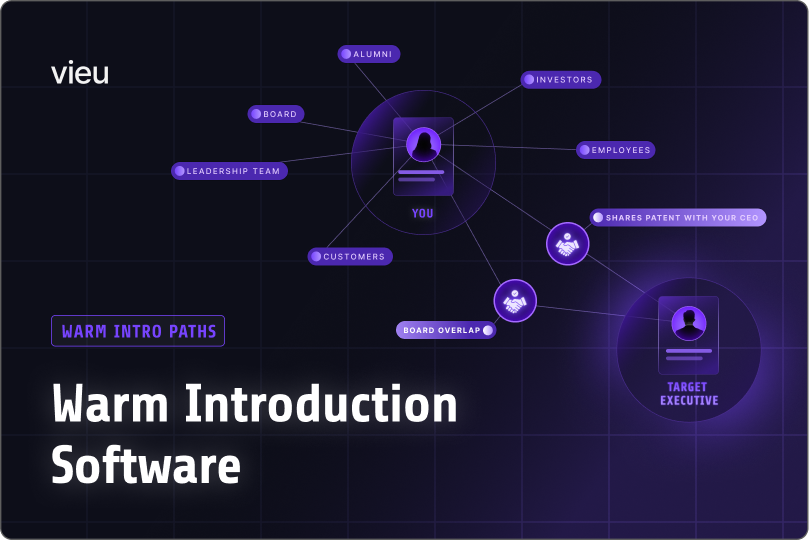
Enterprise ops can track relationship coverage like pipeline. Two numbers make a good start: the share of target accounts with a known warm path, and the share of open deals with an executive sponsor. On Vieu's own numbers, executive-level warm paths get 2.9 times the reply rate of cold outreach.
Vieu gives ops the data for both. It maps inferred and verified relationships across 4 billion people and companies, 14 billion in all, built from shared work history, board seats, co-authored research and joint ventures, so ops can see paths nobody logged. That coverage stays with the company when reps change. And because Claude and Gemini can query it directly, with answers in about 287 milliseconds, it can feed automated account planning without anyone exporting a spreadsheet.
Comp, quotas and capacity planning
A few large deals make results lumpy. Quotas should follow account potential, not a flat number per rep, and ramp plans need to reflect cycles measured in quarters. Ops also decides how to credit multi-year contracts and how to split credit when solutions engineers, partners or executives help close. Capacity planning comes back to coverage: how many named accounts each AE can work properly, and how many AEs the plan needs.
Stack ownership and data hygiene
Ops owns the CRM and everything connected to it: field and stage definitions, integrations, duplicate rules and who can change what. In enterprise, bad data has a bigger cost, because each record is attached to a large deal. A short monthly hygiene review (stale opportunities, missing contact roles, accounts without an owner) prevents most forecast surprises.
How to structure an enterprise sales ops team
Enterprise sales ops usually grows in this order:
- First ops hire: a generalist who owns the CRM, the forecast and the deal desk.
- Deal desk: a dedicated person once approvals start slowing deals.
- Sales ops analyst: reporting, dashboards and forecast analysis.
- Systems admin: the CRM and integrations, once there's enough customization to need a specialist.
- Head of sales ops or RevOps leader: owns the team and sits with the CRO in planning.
Merge sales ops into revenue operations when marketing ops and customer success ops are building the same reports from the same data, or when one leader owns all revenue.
Enterprise sales operations KPIs
The warm path metric is the one most teams can't report today, because the data has never been in the CRM.
The enterprise sales ops tech stack
For a deeper look at each layer, see our guide to enterprise sales software.
- Vieu: the relationship data layer for account planning and executive coverage on strategic accounts. It sits alongside the CRM.
- CRM (Salesforce, HubSpot): the system of record.
- CPQ and deal desk (Salesforce Revenue Cloud): quotes, approvals and non-standard terms. It succeeds Salesforce CPQ, which stopped being sold to new customers in March 2025.
- Forecasting (Clari Forecast, now part of Salesloft): roll-ups and deal risk.
- Conversation intelligence (Gong): call data that feeds deal inspection and forecasting.
- Contact and company data (ZoomInfo): keeping account and contact records complete.
Standing up enterprise sales ops in 90 days
Days 1 to 30: audit and data model
- Audit CRM fields, stages and data quality; close or fix stale opportunities.
- Agree the named-account list and tiers with sales leadership.
- Add buying-committee contact roles to opportunities.
- Baseline relationship coverage: which tier-one accounts already have a known warm path.
Days 31 to 60: process
- Set the deal desk approval matrix and turnaround targets.
- Write stage exit criteria and add qualification fields.
- Start a weekly forecast call built on deal inspection.
Days 61 to 90: reporting and coverage
- Build dashboards for the KPIs above.
- Report stakeholder and executive sponsor coverage on every tier-one deal.
- Review the first full month of forecast accuracy and adjust.
FAQ
What does an enterprise sales operations manager do?
An enterprise sales operations manager runs the systems and processes behind a team selling large deals. That usually means owning named-account territories, the deal desk and approvals, the forecast, CRM data quality and reporting, so sales leaders can predict revenue and reps can focus on their accounts.
What's the difference between sales operations and revenue operations?
Sales operations supports the sales team: territories, quotas, forecasting, the deal desk and the CRM. Revenue operations brings sales, marketing and customer success operations into one team with shared data, systems and reporting. Many companies start with sales ops and expand it into RevOps as they grow.
What KPIs should sales operations track?
For enterprise teams, the core set is forecast accuracy, sales cycle length, win rate on named accounts, discount rate and approval time, stakeholders engaged per opportunity, executive sponsor coverage, pipeline coverage and AE ramp time. Many teams now add the share of target accounts with a known warm path.
When should a company hire its first sales ops person?
Usually when sales leaders spend more time fixing the CRM, building the forecast or chasing approvals than coaching reps. For companies moving upmarket, the first large deals are often the trigger, because deal desk work and deal-by-deal forecasting arrive with them.
What tools does sales operations use?
The core is a CRM such as Salesforce or HubSpot, plus CPQ for quotes and approvals, a forecasting tool, conversation intelligence and a contact data provider. Enterprise teams increasingly add relationship intelligence such as Vieu, which shows who can introduce them to each account's decision-makers.
If your forecast depends on relationships your CRM can't see, start by finding out what your account coverage really looks like.
Get your first 25 intros free →